

Anica's Story
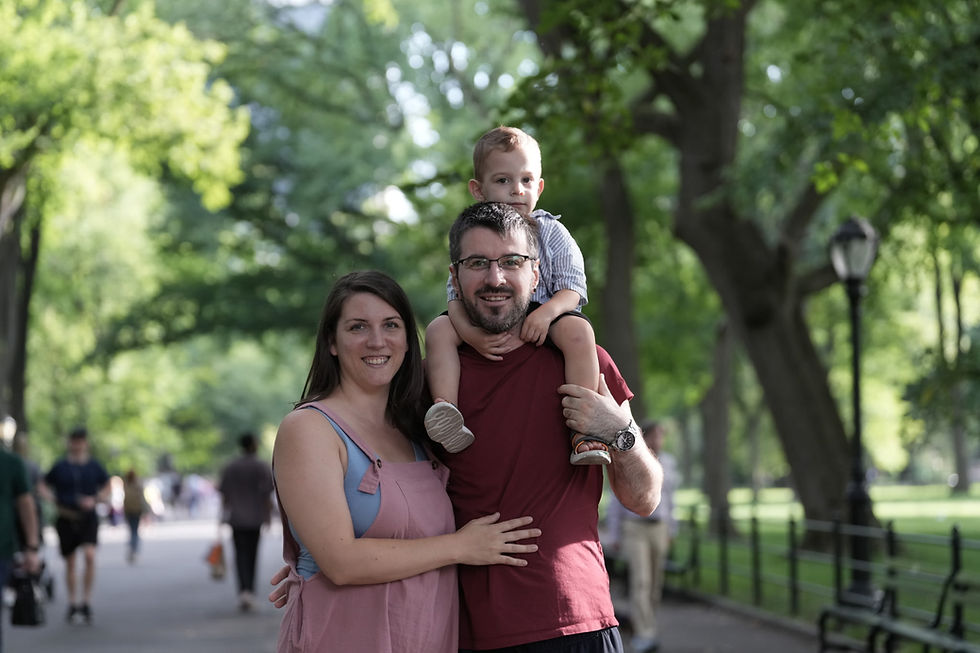
My family has been part of The Child Center of NY since my son, Luka, was just three weeks old. He is now 2 and a half, and he is enrolled in Early Head Start in Astoria. Before that, I was part of the perinatal program in Flushing. It has been such an important part of our lives, and I truly feel like The Child Center is my family here.
My husband and I came to the United States for our honeymoon. When COVID happened, we couldn't find a place on a plane to go home. We ended up having to survive the pandemic on the other side of the world from everything we knew. When the pandemic was over, we decided to try to build a life here.
Then I had a very traumatic birth. Two weeks after Luka was born, I went to Elmhurst Hospital for my first checkup. I started crying and told them, “Something is wrong. I can't do this. I don't want to do this.” I was severely dissociated and struggling with PTSD and anxiety. My husband works approximately 80 hours a week, so I was alone with our child much of the time. I remember feeling like I couldn't adjust to being alive, to be honest.
The nurses at the hospital connected me with a social worker, who then connected me with Ms. Beverly [Gould], program director of The Child Center’s Macari Perinatal Intensive Outpatient Program. A few days later, Ms. Beverly called and asked me a million questions in the most compassionate and professional evaluation imaginable. Then she invited me to join the perinatal program for moms experiencing postpartum depression.
I went for the first time when Luka was three weeks old. I remember how warmly they welcomed me. They took Luka to the nursery, a clean and inviting room filled with age-appropriate toys and smiling, calm employees taking care of the babies. I went into a room with five or six other mothers. They were all in the same place in life that I was. That was a lifesaving moment for me.
From that day forward, I went every week for an entire year.
The perinatal program saved my life because I wasn't alone. Postpartum depression is very specific. You have to go through it to understand it. People think you automatically fall in love with your baby as soon as you have them, but that wasn't my experience. I didn't understand what was wrong with me, and I desperately wanted those feelings to stop.
Then I met other mothers who understood. I could say what I was experiencing and hear another mom say, “Yes, I went through that, too.” I realized I wasn't alone. I also realized I could survive it.
The program gave me everything I needed in one place. The car would pick me up in the morning. I would have breakfast, attend therapy, leave Luka in the nursery so I could focus on myself, participate in group and individual therapy, receive medication management, and have lunch. Then there was another group session before the car brought me home around 3 p.m. It gave me structure, support, and, most importantly, a community.
I learned so much about children and about myself. One therapist, Misty [Gisonda], used to remind us that children don't have a sense of time. To a child, five minutes and five hours can feel like the same thing. I still think about that when Luka is having a difficult moment. I remind myself that he doesn't experience time the way I do.
The program taught me how to regulate myself and how to help regulate my child. It gave me an education that I could take with me into life after the program.
When I graduated from the perinatal program, my therapists, including Hadas [PriPaz], Yessenia [Rodriguez], and Ms. Beverly, threw a huge party for me. I was so proud of myself. It felt like a real accomplishment.
Yessenia, one of the head therapists, then referred me to Astoria Early Head Start. She told me that after having so much support through the perinatal program, I still needed a village when I left. She was right.
At that time, I was worried because Luka was 15 months old and wasn't saying a single word. He understood everything and was a smart child who loved puzzles and toys, but he wasn't even saying “mama” or “dada.”
The wonderful thing about Child Center is that the whole system is designed to help and support you. Through Early Head Start, a teacher [home visitor] came to our home every week. She told me that we could wait and see how he developed. She continued coming to our house, playing with him and talking with him.
One day, he woke up, said his first word, and he hasn't stopped talking since!
His first word was “nose” because I was breastfeeding him, and he looked at me and said, “Nose.” After that came “yes,” “no,” “bubbles,” and all kinds of other words. Now he sings and talks. Just yesterday he told me, “No, Mama, it's my turn. You're not fair.” I couldn't believe it.
He even speaks two languages. Our original language is Serbian, and he speaks English as well. I can tell English is his first language: He responds immediately in English, and then I ask him how to say something in Serbian. He even surprised me by counting in Spanish. I have no idea where he picked that up! I'm multilingual myself, so I love it.
Early Head Start has a Parent Council that shares in decision-making for the program, and having a role in the Council has become one of my favorite parts of The Child Center. I love that we have the freedom to speak up, ask questions, and ask for explanations. Sometimes there are a lot of “corporate” words, but at the end of the day, we are all just parents. The staff are very open to explaining things to us and making sure we understand how everything works.
It is an honor to have a parent's voice and be able to say, “I like this. I love this. I don't like this.” I am very direct; I don't sugarcoat things. If I don't like something, I will say it. But I also love being able to recognize the people and services that have helped me.
I’m extremely proud of how we worked together to update transition policy so that children and families have a smoother transition starting in classrooms. We also updated and strengthened our Prenatal Services Policy, ensuring that postpartum moms have two months of postpartum-focused support before starting weekly home visits focused on the baby.
Early Head Start also offers socializations, where the children get to play with each other, and the parents can, well, socialize. Luka absolutely loves them. He has a little “girlfriend” there who shares her juice with him, and he gets so excited when I tell him we're going to take the subway to see our friends.
He loves his teacher, Asma [Hossain]. Every time the doorbell rings, he says, “Asma! Asma!” He can't wait to see her. When we’re getting ready for a socialization, and I tell him we're going to see his friends and Asma and play games, he gets so excited and says, “Mama, yay!”
The socializations are wonderful for me, too. The teachers, Diana and Asma, organize workshops where parents can talk about different topics and communicate with each other while the children play. The teachers help take care of the children, and there are opportunities for parents to learn and share their experiences.
There is also a professional who observes the children while they play and gives parents feedback about what their children are doing well and what they might want to pay attention to. It is very beneficial for parents. It isn't just a place to let the kids run around.
I have met so many different people through these programs. One time, I met a father who has three children and homeschools all of them. I had never met anyone who homeschooled before, so I asked him about 10,000 questions! He was so generous to answer all of my questions. It was an amazing opportunity to learn about something I had never experienced. That is what these programs provide—a resource for parents.
Looking back at the last two and a half years, I know how hard they were. I wanted to give up a million times. But I had people from both programs—the perinatal program and Early Head Start—who wouldn't let me give up.
I still think about my first day in the perinatal program. I was a complete mess. I hadn't showered. I hadn't slept. Luka was screaming constantly, and even when he slept, I couldn't sleep because of my PTSD.
I remember going into my first drama therapy session and thinking, “I'm here because I need help. Why am I reading a poem?”
The therapist, Hadas, gave everyone a poem about the sun and the moon. I didn't understand half the words because English isn't my first language, and I wondered why I was sitting there reading poems when I needed help. But I decided to give them a chance.
Hadas asked us to think about the poem in relation to ourselves and our children. She explained the relationship between the sun and the moon and how our children can become the center of our world while we learn to find our own place in that relationship.
I started crying. One of the other mothers comforted me. She told me that what I was experiencing was normal for her, too, and that it would get better. She said, “It doesn't get easier, but it gets more interesting.”
I think about that woman often because she was right. For me, it took about two years. Now I finally enjoy and have fun with Luka. I'm excited about every day and what it will bring.
I am so grateful for everything The Child Center has given us—the Cool Culture pass, the nutritionist, nurse, therapist, and social workers who are there when you need them. Even if I don't use every resource, it is a huge mental relief to know that someone has your back.
That is especially important to me now because I am thinking about having a second child. People ask me if I'm scared, and of course there is some fear. I remember what I went through. But I also know that I have professionals who can support me, and I have peers who understand me. I am still in contact with everyone from the perinatal program. I visit every three or four months, and I try to make donations because I want to give something back. Every few months, I gather things and bring them to the program. I also go because I miss them. They are a huge part of my life.
I have made great friendships through both programs, and I am very proud of the last two and a half years of my life. I am proud because I made it through. I had people who were there for me and who wouldn't let me give up.
I still have an inner voice that sounds like Hadas, Misty, and Yessenia. Every time when things are hard, I hear all three of them: Misty with the theory of trauma response; Yessenia that I have to be careful how I react in moments of distress; and Hadas to be mindful, drink water, stay present, and breathe.
I don't have other family here. The Child Center has become my family.
It is a great community, and I am incredibly grateful. The most important thing is knowing that, whatever happens, there are people who will be there to back me up and help me. After everything I've been through, that means everything.


